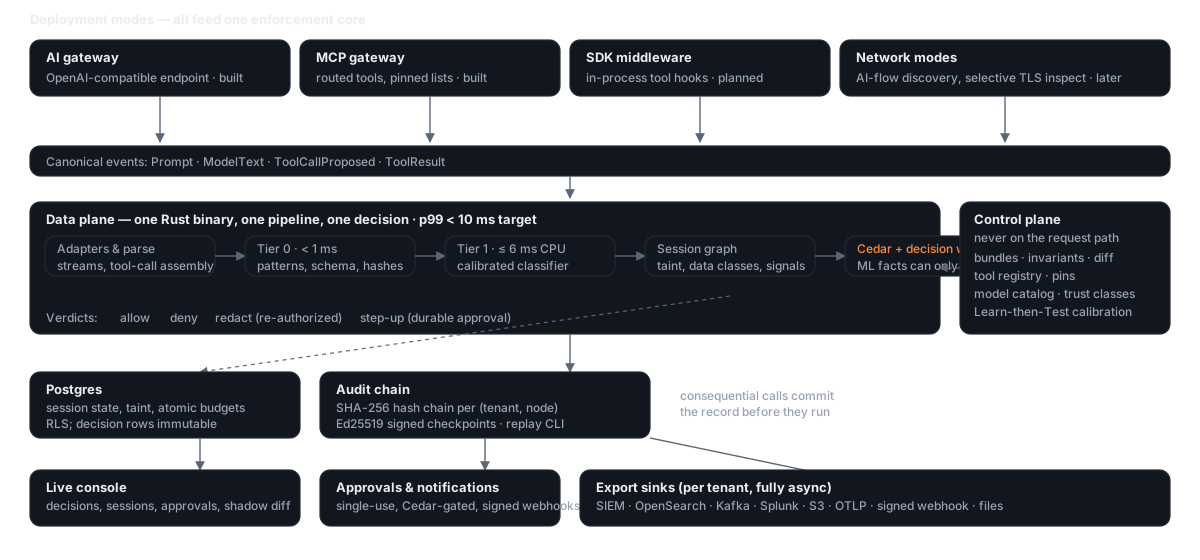
Most AI guardrails are a model judging a model — the judge can be fooled, and you never know
which requests it waved through. InfernoFirewall inverts it: the ML layer emits facts, and a
Cedar policy engine decides. Because ML facts only appear inside forbid conditions, the
allowed set can only shrink. The bound you can state before deployment is the product.
Formally analyzable policy
Semantic diff and invariants. Prove statements like "no prod principal can ever call shell_exec" or "nothing labeled secret reaches an external sink" — the SMT solver answers before the policy ships, with counterexample requests when it doesn't hold.
Tool calls are the attack surface
Agent-first, not text moderation. The real risk is an agent taking a harmful action because untrusted content steered it. Every tool call is an untrusted proposal until policy permits it.
Sub-10 ms fast path
Three tiers. Compiled patterns + schema + Cedar in under 1 ms on every event; a calibrated compact classifier < 6 ms on CPU; an LLM judge only when the classifier is uncertain and the action is high-impact.
Tamper-evident, replayable audit
Every decision is a hash-chained record — inputs, bundle hash, rules fired, scores, approver. Checkpoints are signed with Ed25519, and a verifier CLI exits 1 on any edit or gap. Replay reproduces every verdict; what-if runs a candidate policy over history.
Taint that only grows
Provenance per session. Anything a tool returned is untrusted for the rest of the session, and it flows to summaries, memory and child agents. Policy decides what taint means; it clears only through an audited declassification step.
Approvals bound to exact arguments
Single use, re-decided on release. An approval is tied to the canonical arguments hash — approving $100 never releases $1000. Approver authority is itself a policy, and no approval can override a hard deny.
Tool-description pinning
Against MCP rug pulls. Descriptions and schemas are hashed and pinned at approval. Change them upstream and the tool disappears until re-approval; tool text that contains injection instructions is blocked at sync.
Fail closed
By construction. Deadline exceeded, stage error, panic, unparseable JSON, lost session state: tool calls are always denied. Only plain chat text can opt into failing open.
Outbound data controls
Providers are sinks. The whole request — history included — is scanned, and each backend is decided by its trust class: self-hosted, private or public. Secrets never leave; personal data stays inside commercial APIs.
Learns, but only tightens
Co-evolution with a guard. Blocks and red-team findings are mined into candidate rules; anything the analyzer proves to be a tightening can auto-ship, anything looser requires a named human approver in the audit trail.
Shadow mode
Adopt without disruption. Run the firewall over real traffic, record what it would have blocked or held, and enforce when the false-positive budget is provably acceptable.
Honest evaluation
Four configurations, always reported together: no firewall, static policy only, classifier only, combined — attack success, benign task success, approval burden and latency. We publish what is measured and label what is synthetic.